
Fast, Reliable Spray Foam Insulation Across Grand Terrace
Spray foam insulation in Grand Terrace typically costs $2.50 to $6.00 per board foot installed, with most full attic retrofits landing between $4,800 and $12,000 depending on foam type and existing material removal. We get to Grand Terrace homes fast, usually within 24 to 48 hours for an estimate, and same-week scheduling for most retrofit jobs. If you’re in Grand Terrace and your attic still has the original thin batt from the 1960s or 70s, you’re losing conditioned air every single afternoon. Call (877) 265-9918 and we’ll come look at what’s actually happening up there.
We’re Hometown Insulation Co, led by Nate Cervantes, and we’ve spent years crawling through attics across the Inland Empire. Grand Terrace is a city we know block by block: the older ranch homes off Barton Road, the foothill streets climbing toward Blue Mountain, the tight one-story layouts where every square foot of attic matters. This is retrofit country, not new construction. That changes how spray foam should be applied, and we’ll explain exactly what that means for your house.
Key Takeaways for Grand Terrace Homeowners
- Closed-cell spray foam for roof decks and rim joists runs $3.50 to $6.00 per board foot in Grand Terrace
- Open-cell spray foam for attic floors and interior walls runs $2.50 to $4.00 per board foot
- Most pre-1978 Grand Terrace attics need old fiberglass removed before foam goes in
- We carry Demilec and Icynene spray foam products, plus Owens Corning and Rockwool for hybrid jobs
- Free estimates, and we always tell you if spray foam isn’t the right call for your house
Why Hometown Insulation Co Is Grand Terrace’s Preferred Spray Foam Insulation Company
We’ve spent enough time in Grand Terrace attics to know what works and what doesn’t in this specific housing stock. These aren’t 2005 tract homes with generous attic clearance and modern baffles. Grand Terrace homes are mostly mid-century builds with shallow roof pitches, original 2×4 rafter bays, and decades of accumulated heat damage. That’s the environment we specialize in.
Homeowners here ask us the same three questions: will foam actually stop the summer heat bleed, do I need to pull out the old fiberglass first, and how long before I notice a difference on my SCE bill. We answer all three honestly. In many Grand Terrace homes, a properly air-sealed closed-cell roof deck drops attic temperatures 25 to 35°F by itself. The old batts usually do need to come out, because spraying over compressed, dust-filled fiberglass gives you a foam layer that pulls away from the sheathing within a few seasons. And most customers see a meaningful utility-bill shift in the first full summer after the job.
Nate Cervantes built this company around one idea: match the material to the house, not to what’s easiest for the crew to install. When a Grand Terrace homeowner calls, we show up, measure the actual R-value of what’s already there, check for air leaks at the top plates and can lights, and then recommend a foam type and thickness based on that house’s orientation, roof pitch, and equipment size. That’s why so many Grand Terrace customers send their neighbors our way.
Closed Cell Spray Foam Insulation in Grand Terrace
Closed Cell Spray Foam Insulation is the heavy-hitter for Grand Terrace roof decks and rim joists. At roughly 2 inches of cured thickness, it adds around R-13, creates a vapor barrier, and structurally stiffens the assembly it’s applied to. For a Grand Terrace home with a west-facing roof deck that bakes past 140°F every summer afternoon, closed-cell foam on the underside of the roof sheathing is the single highest-impact change we can make.
A full closed-cell roof deck job in a typical 1,200 to 1,600 square-foot Grand Terrace rancher runs $5,500 to $10,000, including removal of any failed legacy insulation that’s in the way. It’s not the cheapest option. It is the one that actually changes how the attic behaves. If your AC condenser runs from noon to 8 p.m. without cycling off, closed-cell on the roof deck is usually the fix.
Rim Joist and Band Board Sealing
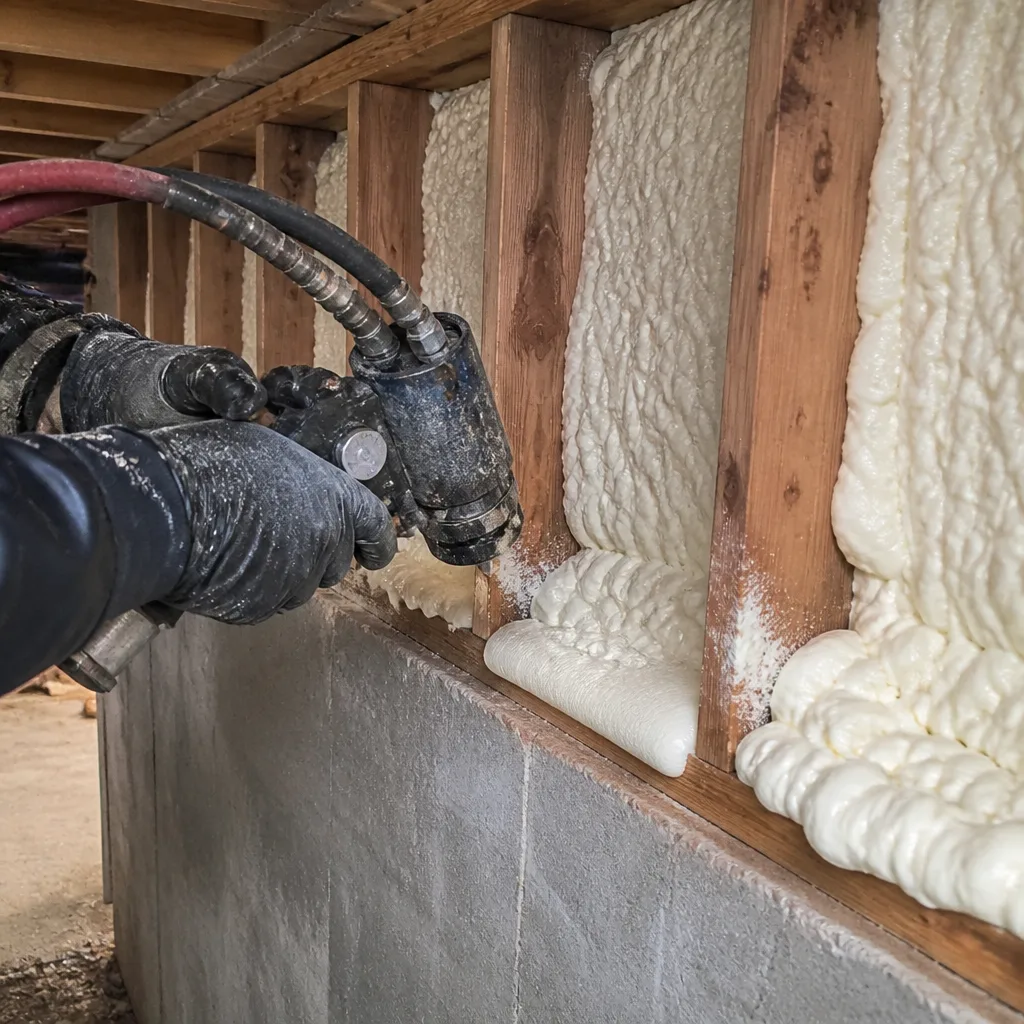
Grand Terrace homes built on raised foundations lose a surprising amount of conditioned air through the rim joist, the wood band that runs around the perimeter of the floor system. We spray closed-cell foam into each rim joist bay to stop that air movement. This alone can cut drafts and make bedrooms over the crawlspace feel noticeably warmer in winter.
Roof Deck Application for Unvented Attics
Many mid-century Grand Terrace homes have no ridge vents, no soffit vents, or vents that were blocked during re-roofs decades ago. Applying closed-cell foam directly to the roof deck converts the attic to an unvented, conditioned space. That’s often the right move here, because it keeps the attic air within 5 to 10 degrees of the living space instead of 40 degrees hotter.
Open Cell Spray Foam in Grand Terrace
Open Cell Spray Foam is the workhorse for Grand Terrace attic floors and interior walls where you want strong air sealing without the higher cost of closed-cell. It expands to roughly 100 times its liquid volume, filling every gap and crack around top plates, wiring penetrations, and ceiling joist bays. At 5.5 inches, it delivers about R-21, and it’s good at sound control too.
For a Grand Terrace home where the roof deck already has adequate ventilation and the main problem is heat radiating down through the ceiling, open-cell on the attic floor is the right call. Expect to pay $2.50 to $4.00 per board foot, with a typical 1,400 square-foot attic floor running $3,200 to $5,800 after old insulation removal. It’s the most common spray foam job we do in this city.
Attic Floor Coverage and Air Sealing
Before we spray open-cell on a Grand Terrace attic floor, we seal the top plates, can lights, and any chase ways with closed-cell or acoustical caulk. Then the open-cell goes down in a continuous blanket. That two-step process is the difference between foam that performs and foam that just fills space.

Interior Wall and Sound Control Applications
Grand Terrace homes close enough to the 215 freeway or the rail corridor get real noise bleed through exterior walls. Open-cell spray foam in those wall cavities cuts sound transmission meaningfully while also sealing the thermal envelope. We recommend it for bedrooms facing Barton Road or the rail line.
Trusted Brands We Service in Grand Terrace
We carry Demilec and Icynene spray foam products because those are the two brands we’d want in our own Grand Terrace houses. Demilec’s closed-cell formulations give us consistent cell structure in high-heat attics, which matters when the roof deck is already 130°F during application. Icynene’s open-cell product is dependable for attic floor work. We also keep Owens Corning and Rockwool on hand for hybrid jobs where a Grand Terrace homeowner wants foam on the roof deck and mineral wool in interior walls. Insulation is all we do, and carrying the right products for this city’s housing stock is part of that.
Common Spray Foam Insulation Problems We See in Grand Terrace Homes
- Sagging, compressed original fiberglass batts. The 1960s and 70s homes across Grand Terrace were built with 2 to 3 inches of fiberglass batt, and four decades of triple-digit heat have flattened it to near nothing. We routinely find attic floors where the batts look fine from the hatch but measure R-5 or less in the heat-affected zones.
- Delaminated radiant barriers and foam pulling away from rafter bays. West- and south-facing roof decks in Grand Terrace get hot enough that older spray foam jobs, applied without proper surface preparation, start to separate from the sheathing. We see this on homes where a previous contractor sprayed over dirty or dusty sheathing.
- Unsealed top plates and can lights leaking conditioned air. Pre-1978 Grand Terrace homes almost never had air sealing done at the framing stage. The gap where interior walls meet the ceiling is a direct open channel from the attic into the living space, and it’s invisible until you look for it.
- Blocked or missing attic ventilation causing trapped heat and moisture. Some Grand Terrace attics have ridge vents that were covered during roof replacements, or soffit vents that got painted over. Trapped heat and humidity degrade foam adhesion and accelerate the failure of whatever insulation is already up there.
Pricing for Spray Foam Insulation in Grand Terrace, CA
Here’s what Grand Terrace homeowners should expect to pay, based on the jobs we’ve actually done in this city:
- Open-cell attic floor (1,200 – 1,600 sq ft): $3,200 – $5,800
- Closed-cell roof deck (1,200 – 1,600 sq ft): $5,500 – $10,000
- Rim joist sealing (full perimeter): $900 – $2,200
- Garage ceiling spray foam: $1,200 – $2,600
- Old insulation removal (per 500 sq ft): $400 – $800
The biggest cost variable in Grand Terrace is removal of the original fiberglass. Homes that still have a clean, intact batt layer cost less to prep. Homes where the batts have collapsed, been damaged by rodents, or been compressed by decades of storage boxes cost more, because we’re removing material before we spray. We give you a fixed price after the attic inspection, not after the job starts. Call (877) 265-9918 to schedule a free estimate.
We Also Serve Cities Near Grand Terrace
Hometown Insulation Co serves Grand Terrace and the surrounding Inland Empire communities, including Highgrove, Colton, Rubidoux, and Bloomington. If you’re in one of those cities and want the same straight answers about Spray Foam Insulation, call us. Grand Terrace area crews travel to all four routinely, and we know the housing stock in each one.
Serving Grand Terrace, CA — Our Local Coverage Area
We’re based in the Grand Terrace area and know this community well. Use the map below to see our service coverage — if you’re nearby, we can almost certainly help.
FAQs About Spray Foam Insulation in Grand Terrace
Spray foam is the better fit for most 1960s Grand Terrace attics because those homes leak air at the top plates and can lights, and loose fill doesn’t fix air leaks. Blowing more cellulose or fiberglass over an already-failing batt layer just buries the problem. Spray foam both insulates and air-seals, which is what a mid-century attic with original framing gaps actually needs. Call (877) 265-9918 and we’ll tell you if your attic is a foam candidate or a loose-fill candidate after we look at it.
In almost every case, yes. Spraying foam directly over old fiberglass batts in a Grand Terrace attic means the foam adheres to the batts, not to the sheathing or joists, and it will pull away within a few seasons. The batts are usually compressed, dust-filled, and sagging off the floor anyway. We remove them, clean the surface, seal the penetrations, and then spray. This is standard practice for pre-1978 homes in this city.
No. Closed-cell foam on the roof deck converts the attic to an unvented, conditioned space. The attic air stays close to the living space temperature because the foam stops the radiant heat from the roof sheathing before it enters the attic air. Grand Terrace homes with west-facing roof decks see the biggest temperature drops, often 25 to 35°F at the peak of the afternoon.
Because Grand Terrace has essentially no new construction, every spray foam job here is a retrofit, and that means pricing includes time for old insulation removal, air sealing, and surface prep. New-build crews can spray straight onto clean framing and walk away. In Grand Terrace, we’re working around existing homes, old wiring, and legacy materials, so labor runs higher here than in newer Inland Empire tracts. The tradeoff is a measurable result on an existing energy bill, which you don’t get from building new. Schedule a free estimate and we’ll give you a fixed number for your specific attic.
For a 1950s Grand Terrace home with a west-facing attic, we recommend 2 inches of Demilec closed-cell spray foam on the underside of the roof deck, plus 5.5 inches of Icynene open-cell on the attic floor if the budget allows. That combination gives you an air-sealed roof deck that stops radiant gain and a thick thermal blanket at the ceiling line. If we’re doing one or the other, the closed-cell roof deck is the priority for west-facing heat. Call (877) 265-9918 for a detailed recommendation after an attic inspection.
Contact Hometown Insulation Co for Spray Foam Insulation in Grand Terrace
If you’re tired of paying to cool an attic and still having bedrooms that never hold temperature, we’ll come look. Free estimate, honest recommendation, no obligation. Nate Cervantes and the Hometown Insulation Co crew serve Grand Terrace and the surrounding foothill communities, and we know exactly what’s hiding in the attics around here because we’re in them all summer. Call (877) 265-9918 to schedule your estimate.
Written by Nate Cervantes, Owner at Hometown Insulation Co, serving Grand Terrace and the Inland Empire.